
Chapter 8: Bid Price vs Ask Price
Chapter 8: Bid Price vs Ask Price
Whenever you view a live currency quote on a trading platform, you will notice that every Forex pair displays two different prices simultaneously rather than a single value. These two prices are the Bid Price and the Ask Price. The tiny difference between them is called the Spread, which represents the primary transaction cost of trading Forex.
1. Defining Bid and Ask
Understanding Bid and Ask comes down to viewing the trade from the broker’s perspective (or the marketplace). As we learned in Chapter 5, your trade is always relative to the Base Currency.
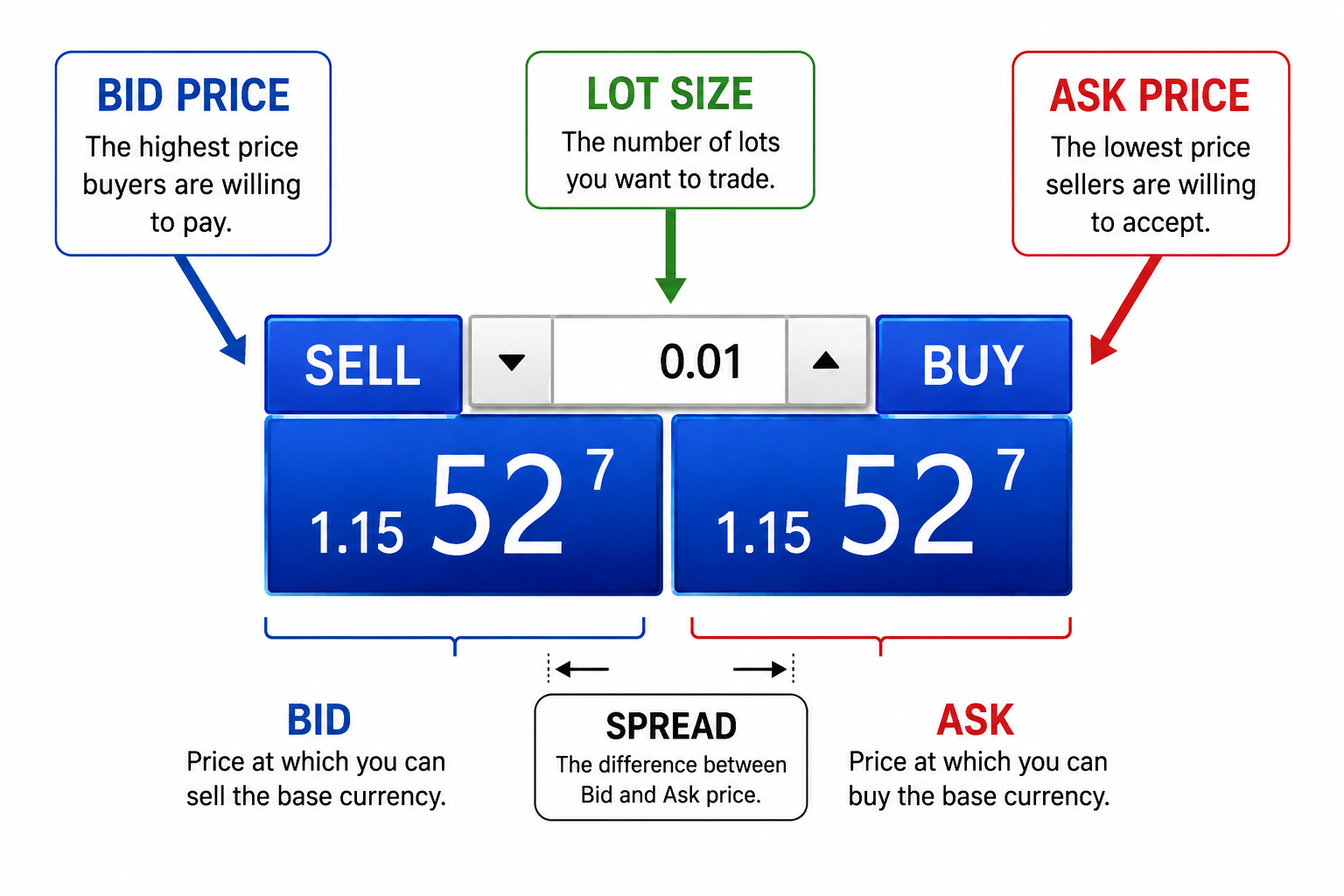
A. The Bid Price (Price to SELL)
- Definition: The highest price the market (broker/buyers) is currently willing to pay to buy the base currency from you.
- Your Action: This is the price you get when you click SELL (going short).
- Location: Displayed on the left side of a broker quote.
B. The Ask Price (Price to BUY)
- Definition: The lowest price the market (broker/sellers) is currently willing to sell the base currency to you. It is also called the Offer Price.
- Your Action: This is the price you pay when you click BUY (going long).
- Location: Displayed on the right side of a broker quote.
Golden Rule: The Ask Price is ALWAYS higher than the Bid Price. You always buy high (Ask) and sell low (Bid).
2. Real-World Quote Breakdown
Imagine you open MetaTrader or TradingView and look at GBP/USD:
- Bid: 1.26480
- Ask: 1.26495
| Your Intended Action | Applicable Price | Exact Rate Applied |
|---|---|---|
| You open a BUY (Long) order | Ask Price | You enter the market at 1.26495 |
| You open a SELL (Short) order | Bid Price | You enter the market at 1.26480 |
| You close a BUY position | Bid Price | You sell back to the market at 1.26480 |
| You close a SELL position | Ask Price | You buy back from the market at 1.26495 |
3. What is the Spread?
The Spread is the difference between the Ask Price and the Bid Price:
Using the GBP/USD example above:
Why Does the Spread Exist?
The spread is how retail Forex brokers make their profit for executing your trades without charging upfront commissions. Because you enter a buy position at the higher Ask price and exit at the lower Bid price, every trade starts at a minor floating loss equal to the spread amount.
4. Key Factors Influencing Bid-Ask Spreads
Spreads are not fixed; they fluctuate continuously based on market conditions:
- Liquidity: Major pairs (as we saw in Chapter 6) like EUR/USD have massive liquidity, keeping their spreads extremely tight (often 0.1 – 0.8 pips). Exotic pairs like USD/TRY have low liquidity, resulting in wide spreads (20 – 100+ pips).
- Trading Hours: Spreads are tightest during overlapping sessions (London/New York) and widen significantly during quiet off-hours (like the Sydney open).
- High-Impact News Events: During major economic announcements (e.g., US Non-Farm Payrolls or CPI releases), brokers temporarily widen spreads to protect themselves against rapid price spikes.
5. Summary Key Takeaways
- Bid = Sell Price (Left side | Price you sell at).
- Ask = Buy Price (Right side | Price you buy at).
- Ask is always higher than Bid.
- Spread = Ask – Bid (The broker’s service fee).