
Chapter 5: Forex Trading Sessions Explained
Chapter 5: Forex Trading Sessions Explained
In Chapter 3, we established that the modern Forex market is a decentralized Over-The-Counter (OTC) network. Because there is no central physical exchange, the market operates 24 hours a day, 5 days a week. Trading moves continuously around the globe, following the sun as major financial centers open and close throughout the day.
Understanding when the market is most active—and when liquidity peaks—is essential for timing your trades effectively and avoiding dead, choppy price action.
1. The Four Major Forex Trading Sessions
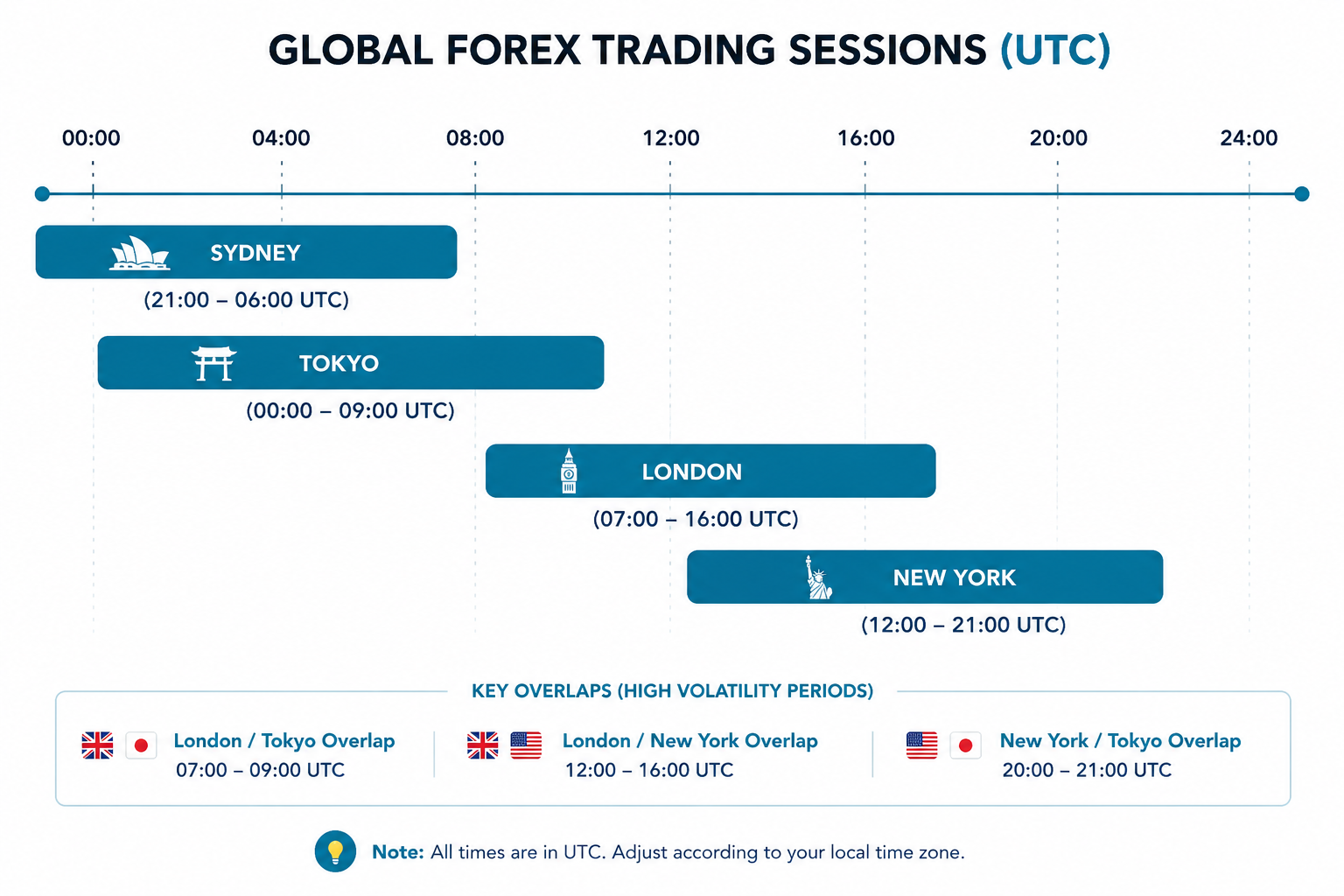
The trading day is divided into four major financial hubs: Sydney, Tokyo, London, and New York. (Note: Exact local hours adjust slightly during Daylight Saving Time, but standard market hours operate continuously from Sunday 5:00 PM EST through Friday 5:00 PM EST).
2. Session Characteristics Breakdown
A. The Sydney Session (Asian Pacific)
- Active Hours: ~21:00 to 06:00 UTC
- Key Currencies: AUD, NZD, JPY
- Market Dynamics: The start of the global trading day. Volume is generally lighter, and market movements are typically calmer compared to European or US hours. Ideal for range-trading strategies.
B. The Tokyo Session (Asian Session)
- Active Hours: ~00:00 to 09:00 UTC
- Key Currencies: JPY, AUD, NZD, SGD
- Market Dynamics: Commercial bank interest and Japanese central bank data drive early volatility. Japanese Yen pairs (like USD/JPY and EUR/JPY) experience their primary liquidity during this window.
C. The London Session (European Session)
- Active Hours: ~07:00 to 16:00 UTC
- Key Currencies: EUR, GBP, CHF
- Market Dynamics: The largest and most volatile session. London handles roughly 35–40% of global daily FX volume. Major trend breakouts, institutional order entries, and key economic news releases occur during these hours.
D. The New York Session (American Session)
- Active Hours: ~12:00 to 21:00 UTC
- Key Currencies: USD, CAD, EUR, GBP
- Market Dynamics: Fueled by Wall Street activity and critical US economic data releases (like NFP and CPI). The opening hours drive extreme momentum across all USD-denominated pairs.
3. Session Overlaps: The High-Volume Windows
When two major financial centers are open simultaneously, liquidity and trading volume surge. These overlap windows present the best trading opportunities for momentum and volatility traders.
1. Tokyo / London Overlap (07:00 – 09:00 UTC): A moderate liquidity spike as Asia closes and Europe opens.
⭐ 2. London / New York Overlap (12:00 – 16:00 UTC) — THE GOLDEN WINDOW
This 4-hour window is often called The Golden Window of Forex trading. It accounts for more than 50% of all daily Forex transactions. Spreads on major pairs like EUR/USD and GBP/USD contract to their absolute tightest levels. Large institutional trends established in London often accelerate as US capital enters the market.
4. Session Comparison Summary
| Trading Session | Volatility Level | Average Liquidity | Best Currency Pairs to Trade |
|---|---|---|---|
| Sydney | Low | Low | AUD/USD, NZD/USD, AUD/JPY |
| Tokyo | Moderate | Moderate | USD/JPY, EUR/JPY, AUD/JPY |
| London | High | Very High | EUR/USD, GBP/USD, EUR/GBP, GBP/JPY |
| New York | High | Very High | EUR/USD, GBP/USD, USD/CAD, USD/JPY |
| London/NY Overlap | Extreme | Maximum | All Major & Cross Pairs |
5. Core Takeaways for Traders
- Avoid Trading During Low-Volume Lulls: The quiet hours between the New York close and the Asian open often suffer from wider spreads and unpredictable, choppy price movements.
- Focus Your Time: You do not need to sit in front of charts all day. Pick 2–3 hours during a major session overlap (e.g., the London/New York open) to trade when market momentum is at its peak.